Investor Relations
Equity Story
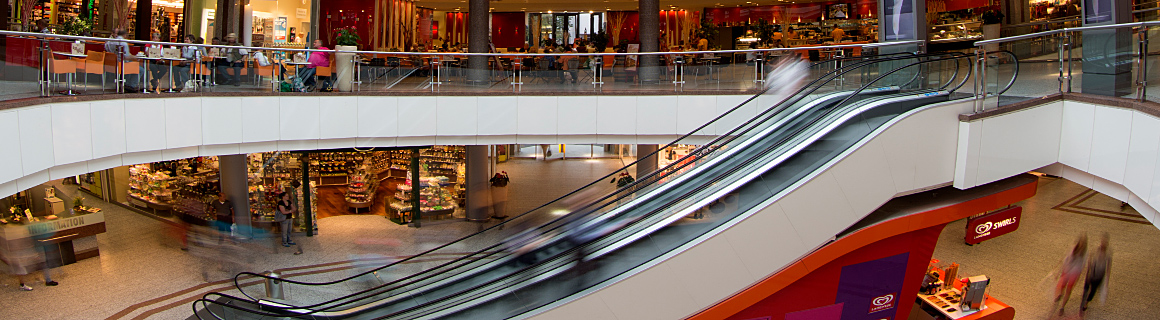
Shopping centers in general
Market driven blend of sectors and tenants
The development of shopping centers has always been linked to changes in customers’ consumer behaviour. As a result, shopping centers have a consistent leitmotif, which is reflected in its blend of location- and market driven sectors and tenants. In order to meet these demands, a shopping center first needs extensive market, location and feasibility analyses.
Attractiveness – the sum of a range of factors
The attractiveness, and therefore the long-term success, of a shopping center depends on a large number of factors. Deutsche EuroShop AG sees modern design, a central location and hence proximity to customers or the available buying power as crucial elements. Among other things, the shopping center properties in Deutsche EuroShop AG’s portfolio were selected because of the exceptional quality of their locations.
Market segmentation
Shopping center locations in Germany differ from region to region. While predominantly large-scale centers have sprung up on greenfield sites in Eastern Germany in recent years, more and more arcades and galleries have been established in city center locations in Western Germany. Over the coming years, we expect to see increasing segmentation of the market. On the one hand, we will have inner-city centers offering high quality and hence higher priced goods, which is increasingly being supplemented by entertainment facilities. On the other hand, self-service department stores and discounters offering more competitively priced goods will primarily be located on greenfield sites.
Market knowledgeIn particular, successful real estate investments in commercial and retail properties require special market knowledge, years of experience and sector-specific information that private investors generally either do not have or can only acquire as a result of considerable effort. In addition, investments in larger properties are characterised by a high capital outlay that can rarely be raised by individual investors.
Useful links:
 German Council of Shopping Places
www.gcsp.de
 European Council of Shopping Places
www.ecsp.eu
- EHI Retail Institute
www.ehi.org/nc/en.html
- IREBS - International Real Estate Business School
www.irebs.de

Indices
EPRA - Index

The European Public Real Estate Association is the voice of the publicly traded European real estate sector, based in Brussels.
With more than 200 active members, EPRA represents over EUR 250 billion of real estate assets and 90% of the market capitalisation of the FTSE EPRA/NAREIT Europe Index.
Through the provision of better information to investors, improvement of the general operating environment, encouragement of best practices and the cohesion and strengthening of the industry, EPRA works to encourage greater investment in listed real estate companies in Europe. www.epra.com
SDAX
The SDAX is a selection index of Deutsche Börse and comprises 70 companies listed on the regulated market of the Frankfurt Stock Exchange (FWB) that come after the MDAX in terms of size and liquidity. Selection is based on free-float market capitalization and 12-month order book turnover. The SDAX is weighted according to FreeFloat market capitalization, whereby no company may account for more than 10% of the index.
Classic All Share-Index
The Classic-All-Share-Index includes shares from classic sectors that rank below the DAX in size, i.e. from the MDAX and the SDAX, together with the shares of other classic sector companies listed in Prime Standard.
Prime All Share-Index
The Prime-All-Share-Index tracks the performance of all shares listed in Prime Standard. The index is subdivided into 18 sector indices and other, so-called industry groups designed to facilitate performance comparisons between manufacturers of similar products.
CDAX-Index
The CDAX includes the shares of all domestic companies listed in Prime Standard and General Standard. The index represents the German equity market in its entirety, i.e. all companies listed on FWB Frankfurter Wertpapierbörse (Frankfurt Stock Exchange).
HASPAX
HASPAX - the stock index of the Hamburg Sparkasse in collaboration with the Hanseatic Stock Market of Hamburg - has been published since 1996. As a performance index, HASPAX not only takes the proce development of selected Hamburg companies into consideration, but also their dividend distributions. The includes companies have their headquarters or main business activities in the metropolitan area of Hamburg.
F.-A.-Z.-Index
The F.A.Z.-Index is published each trading day since 1961 by Frankfurter Allgemeine Zeitung (FAZ) as a stock index on the German equity market. The Index includes the 100 companies with the highest capitalisation which are traded at the Frankfurt Stock Exchange.
IR-Team

Nicolas Lissner (Senior Manager Investor & Public Relations, left) and Patrick Kiss (Head of Investor & Public Relations, right). More